Linkdfolio Team

A software engineer portfolio is a single page, usually a small site, that shows what you have built, how you approach engineering problems, and where to find your code. It sits next to your resume, LinkedIn, and GitHub rather than replacing them. Your resume gets you through the application form. LinkedIn gets you found. GitHub holds the code. The portfolio connects all three and explains why your work matters.
This guide covers what recruiters and hiring managers look for, what to include, which projects count (especially for junior engineers), three patterns that work, and three honest ways to build one. The short answer: if you are job searching, you probably want a portfolio, and building it does not have to become another coding project.
What is a software engineer portfolio (and do you need one)?
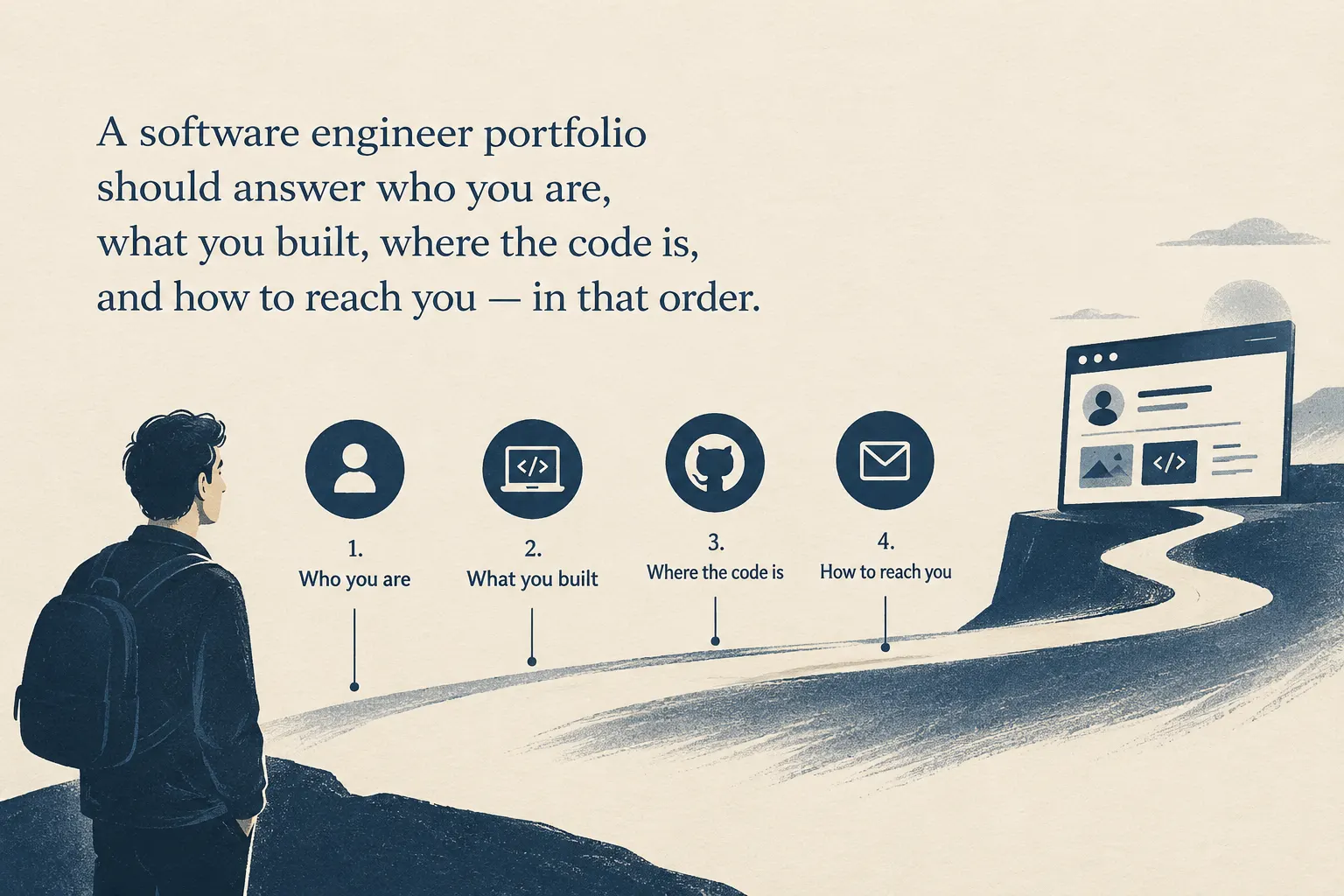
A software engineer portfolio is evidence, not decoration. It lets a reviewer confirm, with little effort, that you can do the work: who you are, a few projects explained well, links to code, and a way to reach you.
Portfolio vs resume vs LinkedIn vs GitHub: what each one does
- Resume: the document applicant tracking systems parse and recruiters skim.
- LinkedIn: where recruiters search and your network sees you. Good for discovery, limited in layout.
- GitHub: the code itself. Hard to navigate for anyone not reading code.
- Portfolio: the curated layer on top, showing which work matters.
LinkedIn has portfolio surfaces too, like Featured and Projects. See what LinkedIn's own portfolio features can do. A separate portfolio is worth it when you need more room.
When a portfolio matters most
- Active job searching, when you want one link for every application.
- New grads and bootcamp grads, where projects carry more weight than a short work history.
- Career switchers who need to show skills their past titles do not.
- Contract work, where clients want to see past work before a call.
If you are not looking, a portfolio is optional.
What hiring managers and recruiters look for in a software engineer portfolio
Common hiring-manager advice describes two passes: a quick scan by a recruiter and a deeper read by the engineering team.
The recruiter's quick scan: role, stack, seniority, and links that work
Recruiters are usually checking fit, not code quality. They want to know the role you are targeting, the languages and frameworks you use, roughly what level you are at, and whether your links work. A clear headline and a tidy project list answer most of that. A broken demo link works against you early.
The engineering manager's deeper read: projects, decisions, trade-offs, and code
Engineering managers read more closely: how you approached a problem, what you chose and why, and whether the code matches the story. Clear and readable tends to beat flashy.
What to include in a software engineer portfolio
These six pieces cover what most reviewers need.
A clear headline: role, focus area, and core tech stack
Open with one line, such as "Backend engineer focused on APIs and data pipelines. Go, Python, PostgreSQL." Skip vague labels like "passionate technologist."
3–5 projects written as short case studies
Give each project the same structure:
- Problem: what you were solving, and for whom.
- Your role: solo, lead, or one contributor among several.
- Key decisions and trade-offs: what you chose and what you gave up.
- Outcome: what works now, what you learned, or what changed for users. Keep it honest.
- Links: a live demo, a repo, or both.
A few short paragraphs per project is enough. Put the strongest one first.
GitHub and code links
Pin the repos you want people to open, each with a README that explains what it does and how to run it. Merged pull requests to open-source projects you use show you can work in someone else's codebase.
Impact from your work experience
Most professional code is private, so describe what you shipped and what changed instead. Name the kind of system, your part in it, and the result in plain terms. Keep it NDA-safe: no internal names, figures, or details your employer would not want public.
Tech stack and skills, grouped and honest
Group skills by area (languages, frameworks, data, infrastructure, tools) and list only what you could discuss in an interview. Skip the logo wall.
Resume, LinkedIn, and contact links
Add a resume download, your LinkedIn, your GitHub, and an email address where they are easy to find on mobile and desktop.
Software engineer portfolio projects: what counts (especially for junior and new-grad engineers)
In a junior software engineer portfolio, projects do most of the work. Good options:
- Your own ideas over tutorial clones. A small app built around a problem you actually had beats a course clone, even if it is simpler.
- Internship and school work you can explain and are allowed to share.
- Open-source contributions, even small documentation or bug fixes in a library you use.
- Small tools that solve a real problem, such as a script, a CLI, or a browser extension people use.
Entry level candidates do not need many projects, just ones they can talk through in detail. Still in school? Our student portfolio from LinkedIn guide covers internships, coursework, and campus roles.
Software engineer portfolio examples: three patterns that work
Use one of these patterns as a starting structure rather than copying someone else's site.
The new-grad portfolio (projects first, internship next)
A headline with your target role and graduation timeline, two or three project case studies, internship experience, then skills and contact links.
The backend / infrastructure engineer portfolio
Fewer visuals, more explanation: case studies about systems you designed or improved, short design write-ups, and reliability work described in plain language.
The web developer portfolio
In a web developer portfolio, the site itself is part of the proof. Reviewers notice layout, accessibility, responsiveness, and how quickly pages load. Live demos matter most here.
Three ways to build a software developer portfolio
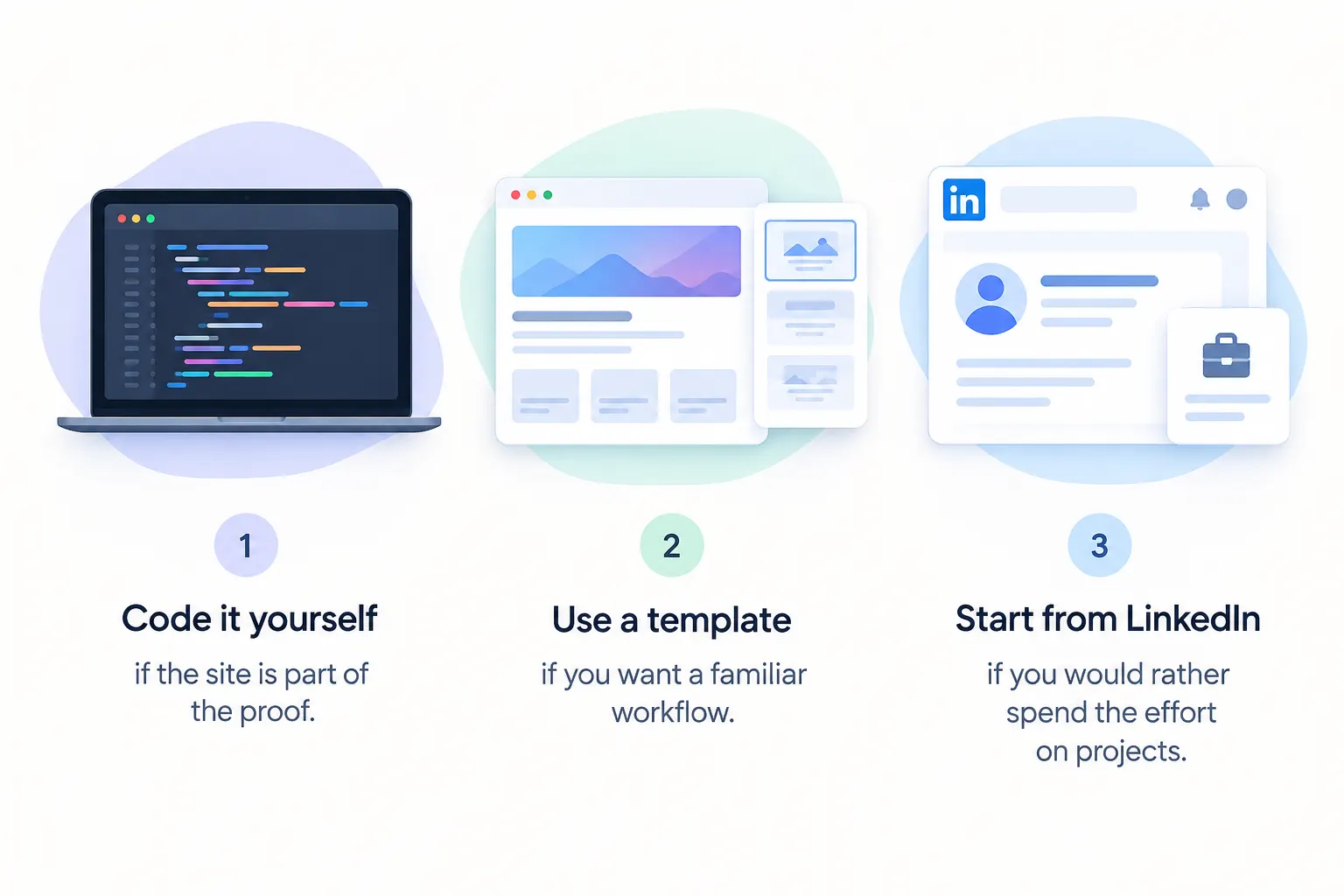
There is no single right way to build a software developer portfolio. It depends on your role and where you want to spend your effort.
Code it yourself, and when that actually makes sense
Coding your own makes sense when you are a front-end or web developer and the site is itself a work sample, when you want full control, or when you enjoy building it and will keep it current. The cost is upkeep, and a half-finished site can hurt more than it helps.
GitHub Pages or a portfolio template
GitHub Pages and open-source templates built with Astro or Next.js are legitimate options: GitHub Pages hosting is free, and the workflow is git. Wix, Squarespace, and Framer suit people who prefer a visual editor. Either way, you still adapt a template, write the content, and maintain it.
Start from your LinkedIn
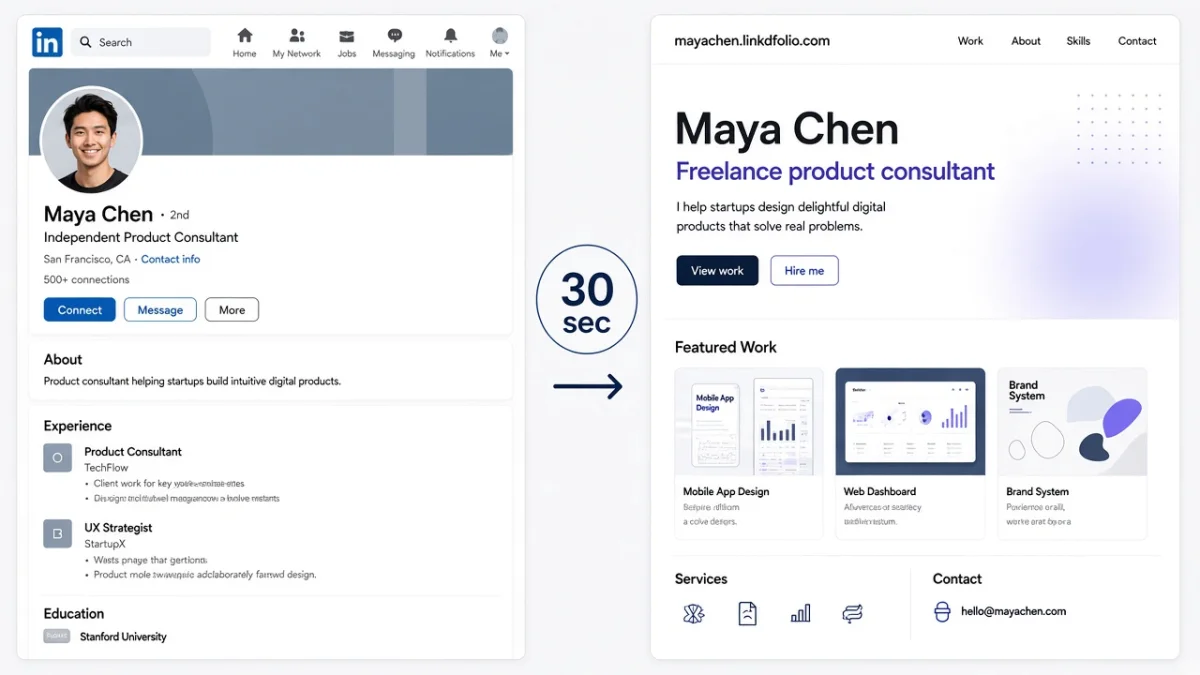
If your LinkedIn is current, a LinkedIn to website tool turns the profile you already maintain into a portfolio site. With Linkdfolio, you paste your LinkedIn and it's built. Your effort then goes into what only you can write: the project write-ups and the links behind them. If that fits, build your developer portfolio website from LinkedIn.
| Approach | Setup effort | Ongoing upkeep | Design control | Best for |
|---|---|---|---|---|
| Code it yourself | High | High | Full | Front-end and web developers, and anyone who enjoys building it |
| GitHub Pages or a template | Medium | Medium | High, within the template | Engineers comfortable with git who want a familiar workflow |
| Start from your LinkedIn | Low | Low | Lower | Engineers who would rather spend effort on projects than on the site |
How to build your software engineer portfolio from LinkedIn, step by step
This is the LinkedIn to website route in four steps. Most of the work is in steps 1 and 3.
Step 1: Tighten your LinkedIn first
- Headline: role, focus area, and core stack.
- Experience: bullets that say what you shipped and what changed, not just duties.
- Skills: the languages and tools you use now, in the order you want to be known for them.
- Projects section: your best projects, each with a short description and a repo or demo link.
Step 2: Paste your LinkedIn URL into Linkdfolio
Go to the developer portfolio website page for software engineers and paste your public LinkedIn URL. That is the whole input: paste your LinkedIn and it's built.
Step 3: Add your projects and GitHub links, then put your strongest work first
Read the result the way a reviewer would. Is your strongest project easy to find? Does each project point to a repo or demo? Is your GitHub link visible? If something is weak, the fix is usually in the content: sharper case-study descriptions, a working link for each, and your best work first.
Step 4: Share it on LinkedIn, your resume, and applications
Add your portfolio to LinkedIn in Contact info and Featured, and put your portfolio link on your resume next to your email and GitHub. Use it in applications too. For the wider search, see our guide to a personal website for your job search.
Common software engineer portfolio mistakes
- Tutorial clones presented as original work.
- Broken demo links, or demos behind a login nobody has.
- Outdated projects at the top, with recent work buried.
- Heavy animation or slow pages that get in the way.
- A long skills list with no proof behind it.
- No way to contact you.
Software engineer portfolio checklist
- Headline states your role, focus area, and core stack
- Three to five projects, strongest first, each with problem, role, decisions, outcome, and links
- Every demo and repo link works in a private window
- Pinned repos have clear READMEs
- Work impact is plain and NDA-safe
- Skills are grouped and interview-ready
- Resume, LinkedIn, GitHub, and email are easy to find
- The page reads well on a phone
- The same URL is on your resume and LinkedIn
FAQ
What should a software engineer portfolio include?
A clear headline with your role, focus area, and core tech stack. Three to five projects written as short case studies: problem, your role, key decisions and trade-offs, outcome, and a demo or repo link. GitHub links with good READMEs. NDA-safe impact from your work experience, a grouped skills list, and resume, LinkedIn, and contact links.
How many projects should a software engineer portfolio have?
Three to five is a common recommendation, and fewer is fine if each one is strong. Reviewers rarely read every project, so quality matters more than count. Put your most relevant project first. For junior and entry-level engineers, two or three projects you can discuss in depth beat a long list you cannot explain.
How detailed should portfolio project write-ups be?
Short enough to skim, detailed enough to show your thinking. A few paragraphs per project usually works: the problem, your role, key decisions and trade-offs, the outcome, and links. Open with a one-line summary for recruiters, then give engineers the detail. Link to the README or a design doc for more.
What makes a developer portfolio stand out to hiring managers?
Clarity and evidence. Common hiring-manager advice favors a site that is easy to read over one that is flashy. Original projects that solve real problems stand out more than tutorial clones, and a stack close to the employer's is easier to evaluate. Clear write-ups about trade-offs, working links, and readable code do more than visual effects.
Do software engineers need a portfolio, or is a resume and LinkedIn enough?
For many experienced engineers, a strong resume and LinkedIn are enough. A portfolio helps most when you are actively searching, early in your career, switching careers, or doing contract work. It complements the resume rather than replacing it.
Is GitHub enough as a software engineer portfolio?
GitHub shows your code, but not which repos matter, what each one solves, or what your role was. Many reviewers will not dig to find out. A portfolio for software engineer roles works best as a short guide on top of GitHub that links to the repos you want read.
Should software engineers code their own portfolio website?
It makes sense for front-end and web developers, where the site is a work sample, or if you enjoy maintaining it. For many backend, infrastructure, and mobile engineers, the projects matter more than the site, so a template or a LinkedIn-based start is often enough.
What projects should a junior or entry-level software engineer include?
Own-idea projects that solve a real problem, internship or school work you can describe and share, open-source contributions of any size, and small tools that people use. Choose projects you can explain in depth.
Can I make a software engineer portfolio without coding?
Yes. Templates and general-purpose site tools cut down on code, and a LinkedIn to website tool starts from the profile you already keep current. With Linkdfolio, you paste your LinkedIn and it's built. You still need clear project descriptions and working links.
Next steps
Your projects are the part of your portfolio only you can write, so let the site be the easy part. Paste your LinkedIn and it's built. Start on the developer portfolio website page for software engineers, then add the link to your resume and LinkedIn.