Linkdfolio Team
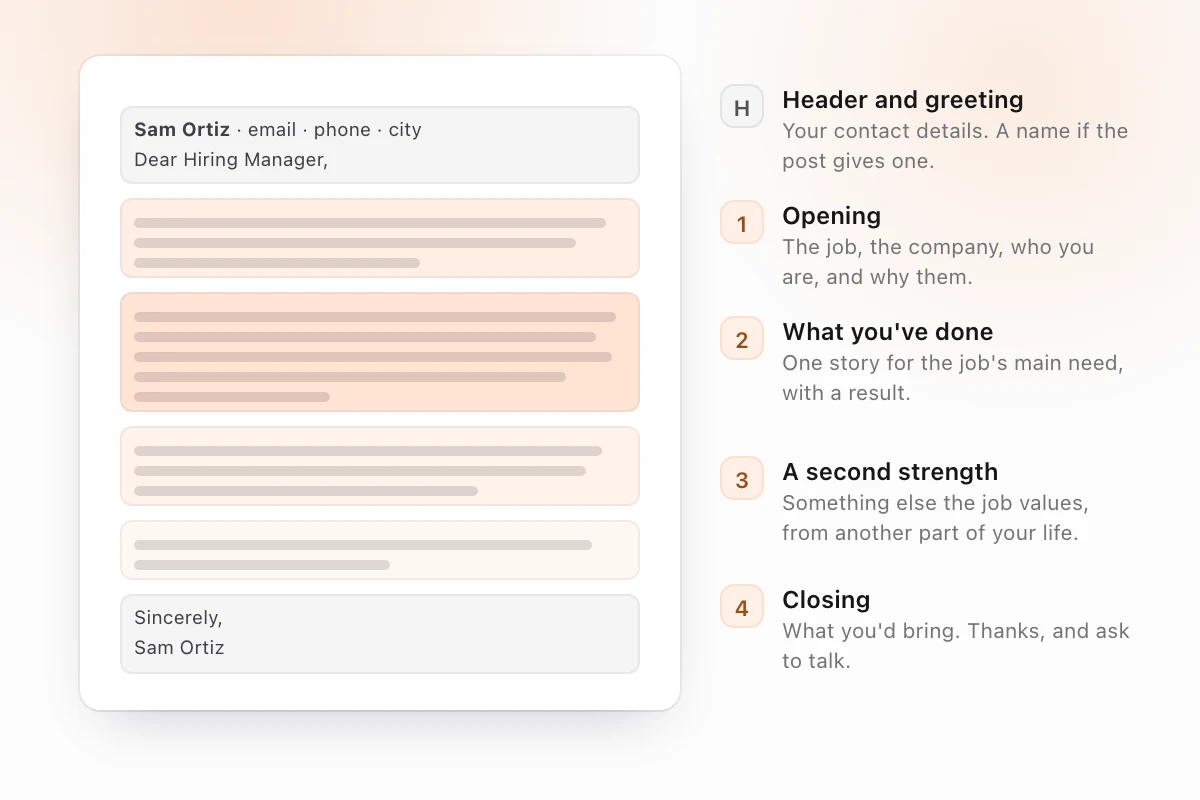
To write a cover letter, read the job post and pick the two or three things the employer needs most. Then write four short paragraphs: an opening that names the job and says who you are, one story from your experience that matches the main need, a second strength from another part of your background, and a close that asks to talk. Keep it to about 200 to 350 words, address it to a person if the post names one, and send it as a PDF.
Your resume lists what you've done. The cover letter picks the one or two things that matter most for this job and tells the reader why. This guide walks through each paragraph, shows how to start and end the letter, and finishes with a complete example for a marketing coordinator job, plus the same paragraph written badly and then fixed.
Before you write: find what the job needs
Most weak cover letters fail before the first sentence, because they are written for any job. Spend five minutes on the post first.
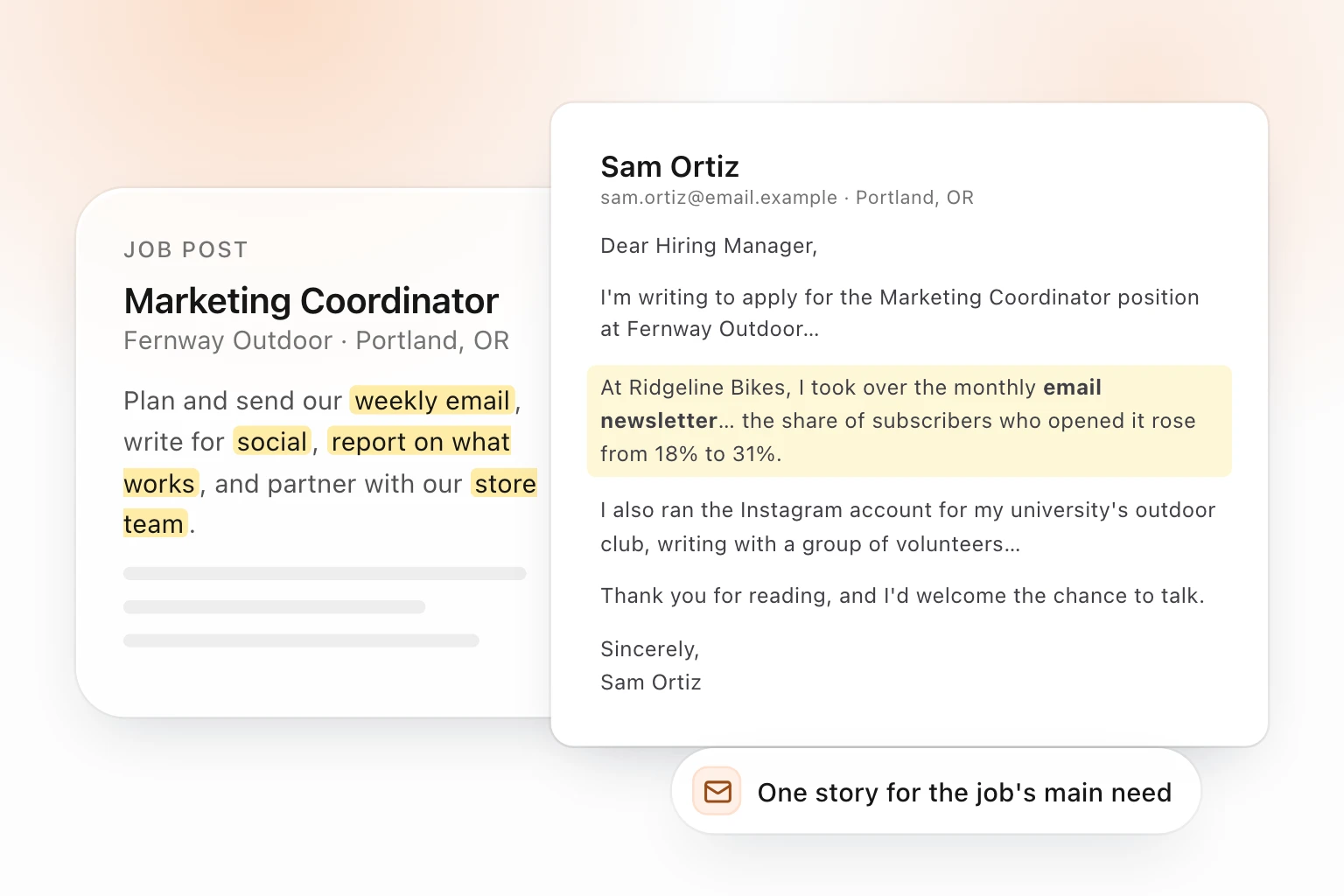
- Read the duties, not just the requirements. The duties tell you what the person in this job does every week. "Plan and send our weekly email and report on results" says more than "2+ years of marketing experience".
- Pick the two or three needs that come up most. Count what the post repeats. If it mentions writing four times and events once, writing is the main need.
- Match each need to one thing you've done. A job, a project, a class, a club, volunteering. You'll use one in paragraph two and one in paragraph three.
- Find one true reason you want this employer. Look at the company's site, recent news or product page. A new product, a store opening or a program you can name is enough. You'll use it in the opening.
You don't need to cover every requirement. A letter that answers the main need well beats one that ticks every box in one line each.
The structure: four paragraphs
| Paragraph | What it does | Length |
|---|---|---|
| 1. Opening | Names the job and the company, says who you are, and gives one reason you want this employer | 2 to 4 sentences |
| 2. What you've done | Tells one achievement that's closest to the job's daily work, and why it mattered | 3 to 5 sentences |
| 3. A second strength | Shows something else the job values, from a different part of your background | 2 to 4 sentences |
| 4. Closing | Says what you'd bring, thanks the reader and asks to talk | 2 to 3 sentences |
Above the body goes a short header and a greeting. Below it go a sign-off and your name.
The header and greeting
Put your name, email, phone number and city at the top, plus a LinkedIn or website link if you have one. A formal letter also adds the date and the employer's name and address. Online applications usually skip the employer's address.
For the greeting, use the hiring manager's name if the post gives it: "Dear Ms. Rivera," or "Dear Alex Rivera,". If it names a team, write to the team: "Dear Fernway Marketing Team,". Otherwise, "Dear Hiring Manager," is fine. Skip "To whom it may concern", which reads as a form letter.
Paragraph 1: the opening
Name the job title and the company in the first sentence, using the post's exact wording. Then say who you are in one sentence: what you do, or what you studied and where you're headed. If you found a real reason to want this employer, give it in one more sentence and tie it to your own work.
Paragraph 2: one story, told well
Pick the achievement closest to what this person will do every week, not the one with the biggest number. Say what you did, what changed because of it, and one number if you have a real one. End with a sentence on what that work showed you or why you want more of it.
This is the paragraph that goes wrong most often, because it turns into a list. See the before and after below.
Paragraph 3: a second strength
Use a different part of your background: another job, a project, leadership, volunteering or how you work with a team. Pick something the post asks for that paragraph two didn't cover. Two or three sentences are enough.
Paragraph 4: the closing
Say in one sentence what you'd bring to this team. Thank the reader, and say you'd welcome the chance to talk. Then sign off with "Sincerely," or "Best regards," and your name.
How to start a cover letter
The first sentence has one job, which is to name the role and the company. These openings all do that. Pick the one that fits your situation.
| Situation | Opening line |
|---|---|
| Any application | I'm writing to apply for the Marketing Coordinator position at Fernway Outdoor. |
| Someone referred you | Dana Lee, who manages your Portland store, suggested I apply for the Marketing Coordinator role at Fernway Outdoor. |
| You have a real reason for this employer | Fernway's new gear repair program gives a marketing team something real to talk about, and I'd like to help tell that story as your Marketing Coordinator. |
| You're changing careers | After four years teaching middle school science, I'm applying for the Training Coordinator role at Brightpath Learning. |
| You're a student or new grad | I'm a communications graduate applying for the Marketing Coordinator role at Fernway Outdoor, and I've spent the last two years writing email and social content for small brands. |
Openings to avoid:
- "My name is…" Your name is already at the top.
- "I am the perfect candidate for…" The reader decides that, and the line sounds like every other letter.
- A quote or a question. "Have you ever wondered…" spends your best sentence on nothing.
- Your whole life story. Where you grew up and why you loved science as a kid can wait for the interview, if it comes up.
If someone at the company referred you, put their name in the first sentence, where the reader will see it right away.
How to end a cover letter
The close is short. Say what you'd bring, thank them and ask to talk:
I'd bring steady writing, careful reporting and real interest in the gear Fernway sells. Thank you for reading, and I'd welcome the chance to talk about the spring campaigns.
Skip "I look forward to hearing from you at your earliest convenience" and "Please do not hesitate to contact me". They add length and say nothing. Your contact details are already in the header.
Before and after: the same paragraph, fixed
Here's paragraph two from a new grad applying for a marketing coordinator job. The job post's main need is "plan and send our weekly email, and report on what works".
Before: the resume written in sentences.
During my internship at Ridgeline Bikes, I managed the email newsletter, created social media content, assisted with in-store events, updated the website and analyzed campaign performance in Google Analytics. I am proficient in Mailchimp, Canva, Google Analytics and Hootsuite, and I am a hard worker who is passionate about marketing.
After: one story, matched to the main need.
At Ridgeline Bikes, a local shop where I interned last year, I took over the monthly email newsletter. I rewrote it around one repair tip per issue instead of a list of sales, and set up link tracking so the owner could see what people clicked. Over six months, the share of subscribers who opened it rose from 18% to 31%. That project showed me how much I like writing something, measuring it and making the next one better.
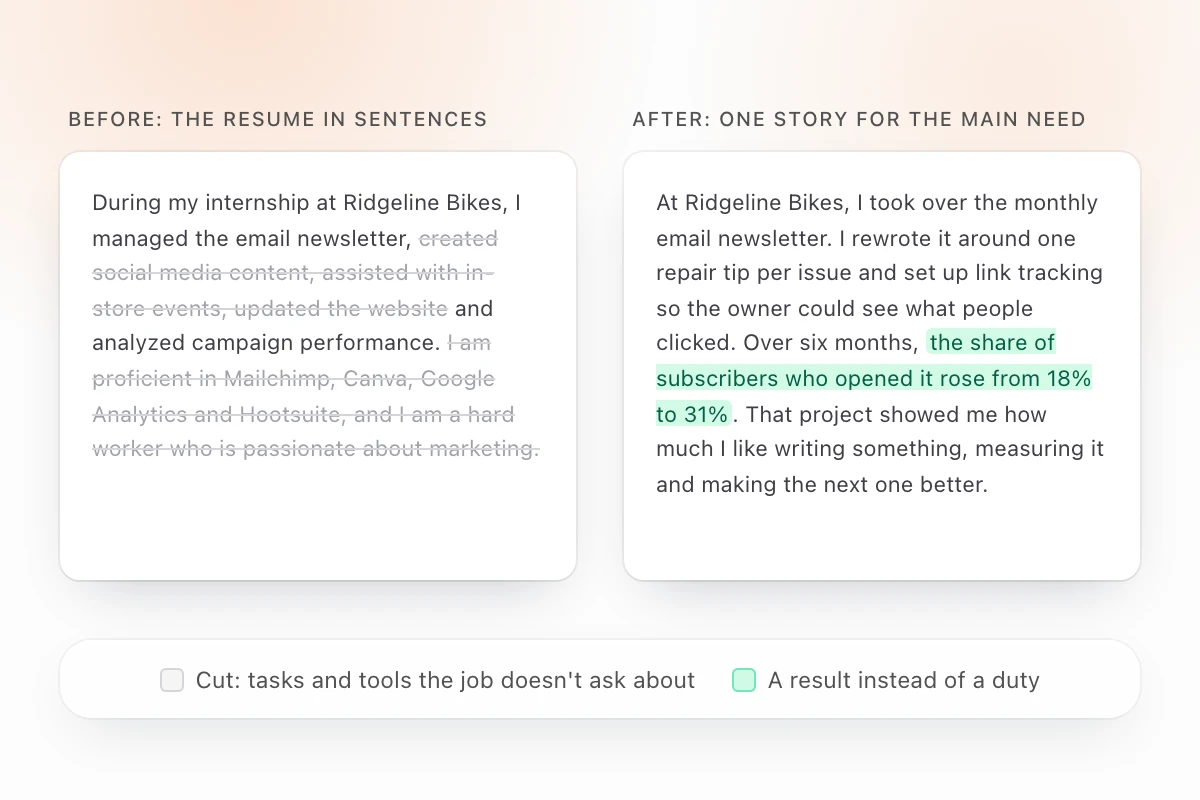
What changed:
- One task instead of five. The email newsletter is the job's main need, so it gets the whole paragraph. The social media, events and website work can wait, or go in paragraph three if the job asks for them.
- A result instead of a duty. "Managed the email newsletter" says you had the task. "Open rate rose from 18% to 31%" says you were good at it.
- The story shows the tools. The tool list belongs on the resume. The link tracking shows the analytics work without naming four apps.
- No adjectives about themselves. "Hard worker" and "passionate" are gone. The story shows both.
Cover letter example
Here's the full letter for the same new grad. The job is a marketing coordinator role at a made-up outdoor gear company, whose post asks for email and social writing, reporting on results, and working with the store team.
Sam Ortiz
sam.ortiz@email.example · (555) 010-4417 · Portland, OR
linkedin.com/in/sam-ortiz-example

Dear Hiring Manager,

I'm writing to apply for the Marketing Coordinator position at Fernway
Outdoor. I graduated in May with a degree in communications, and the
work I do best is writing for a specific audience and then checking
whether it landed. Fernway's new gear repair program gives a marketing
team something real to talk about, and that's the kind of story I'd
like to help tell.

At Ridgeline Bikes, a local shop where I interned last year, I took
over the monthly email newsletter. I rewrote it around one repair tip
per issue instead of a list of sales, and set up link tracking so the
owner could see what people clicked. Over six months, the share of
subscribers who opened it rose from 18% to 31%. That project showed me
how much I like writing something, measuring it and making the next
one better.

I also ran the Instagram account for my university's outdoor club for
two years. That meant planning posts around trips, writing captions
with a group of volunteers and answering questions from new members.
It taught me to keep a shared calendar and to make other people's work
look good, which sounds close to how your team works with the stores.

I'd bring steady writing, careful reporting and real interest in the
gear Fernway sells. Thank you for reading, and I'd welcome the chance
to talk about the spring campaigns.

Sincerely,
Sam Ortiz
That's about 240 words. The opening names the job and gives a reason for this employer. Paragraph two answers the main need with one story and one result. Paragraph three adds teamwork from a different part of Sam's life. The close asks to talk.
Formatting your cover letter
- Length: 200 to 350 words, which fits on one page with room to spare. If it runs past a page, cut the paragraph that does the least for this job.
- Font and margins: use the same font as your resume, 10.5 to 12 point, with margins of about one inch.
- File: send a PDF unless the post asks for something else, and name it clearly, for example
Sam-Ortiz-Cover-Letter.pdf. - Pasting into a form: if the application has a text box instead of an upload, paste the body paragraphs and your name. Drop the header.
- Match your resume. Use the same name, contact details and look on both, so they read as a set.
Mistakes to skip
- Repeating your resume. If a sentence could be a resume bullet, cut it or turn it into the story behind the bullet.
- Writing one letter for every job. Change the opening and paragraph two for each application, at the very least. Those are the parts the reader checks.
- Copying the job post back. "You're looking for a self-starter with strong communication skills, and I'm a self-starter with strong communication skills" tells them nothing new.
- Apologizing for a gap. Don't write "Although I don't have experience with Salesforce…". Talk about what you do have. If the gap matters, it will come up in the interview.
- Getting the company or job title wrong. It happens most when you reuse a letter. Check both before you send it.
- Making things up. Every claim in the letter is something an interviewer can ask about.
How Linkdfolio writes your cover letter
If you'd rather start from a draft, the Linkdfolio cover letter generator follows the same structure, using your own experience:
- It starts from what you've done. Upload your resume or paste your LinkedIn once, and Linkdfolio uses the same experience for every letter you write.
- It writes the four paragraphs for one job. Paste the job post, and it writes a 200 to 300 word letter: an opening that names the job and the company, the achievement closest to the job's daily work, a second strength from a different part of your background, and a close that asks to talk. When it can find something recent the company did, it adds one line on why you want this employer. See how it writes a cover letter for a job description.
- It doesn't make things up. The letter only uses what's in your resume or profile. If the job asks for something you don't have, it leaves that out instead of pointing at the gap.
- It grades the letter against the job. Every new letter gets a grade from Weak to Very Strong, with the strengths and improvements it found, tied to what the job asks for. Many fixes take one click, and you can review the letter again to see how the grade changed.
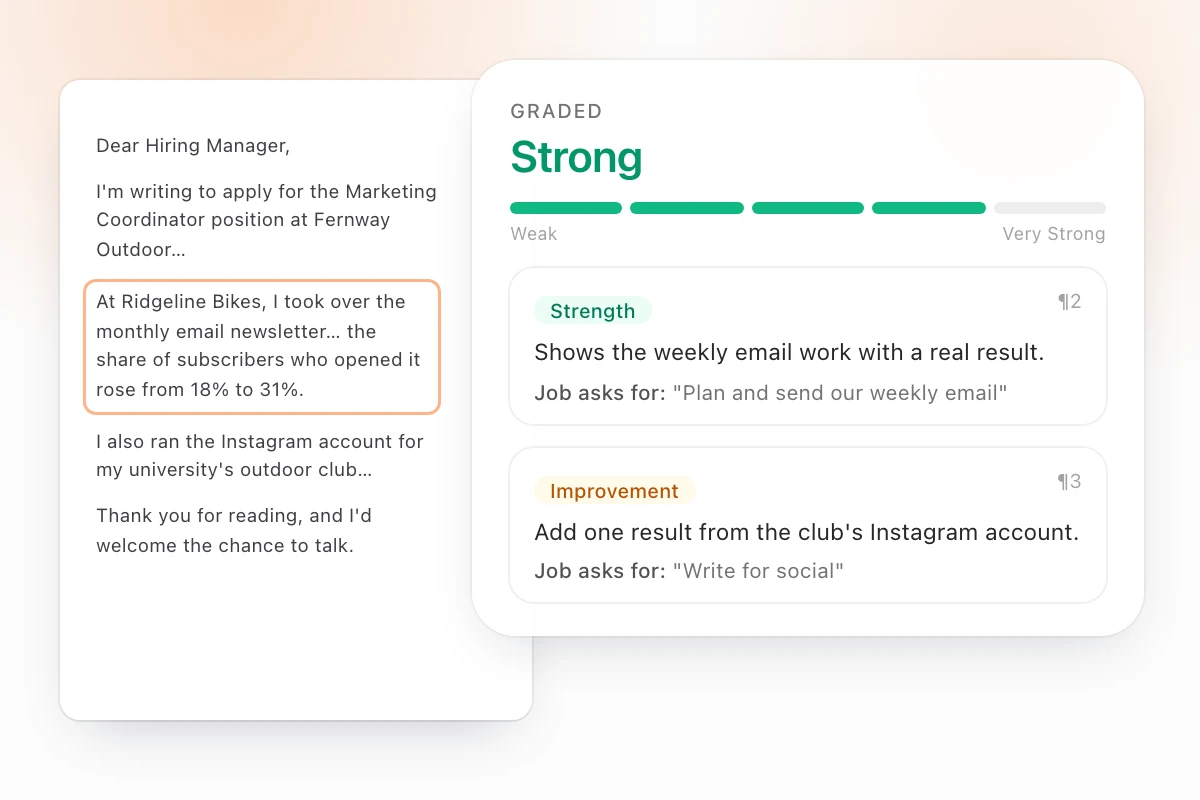
Pick a cover letter template, such as the formal letter, edit any word you like, and download it as a PDF. The free plan lets you write 1 cover letter a month, with 3 AI edits and 1 AI review, and keep 1 letter saved. No credit card needed.
Next steps
- Open the job post and mark the two or three needs it repeats most.
- Match each need to one thing you've done, and write paragraph two first. It's the hardest one.
- Write your letter with Linkdfolio → from your resume or LinkedIn, then change anything that doesn't sound like you.
To get your resume ready for the same job, see which skills to put on your resume. More guides are on the Linkdfolio blog.